

Image source: Maizy Hurlburt
By Samantha Mercer and Maizy Hurlburt
Staff Writers
This year at Hammond, several new policies have been put into place with the intention of fostering a safer and more prosperous learning environment. So what are these policies?
Policies regarding phones, bathrooms, tardiness and school zones have been implemented, each policy with its own motives, hopeful outcomes, and ability to shape future intelligent students and respectable young adults.
The Phone Policy:
With the increased availability of technology to high school students, the problem arises where cell phones can become a distraction in the classroom. In order to combat this issue, a five level system has been created to provide appropriate consequences for phone use. The consequences range from a simple warning to an incident report to administration. A student with their phone out will be given the next level of punishment based on previous incidents.
The purpose behind this new policy is to ensure students are focused on their work and education. Mrs McLean, one of Hammond’s Assistant Principals, informed us that “School isn’t just for cell phones and socializing.”
Administrators found that unhealthy smartphone use distracts students from their studies and hinder their overall performance. However, the students don’t exactly feel the same way. One ninth grader stated “If my telephone is on my desk face down and I’m not using it, there’s no need for you to tell me to put it away.” Another student (10th grade) said “they should make it 3 warnings instead of one [before contacting a parent].” Several students even believe that phones aren’t a distraction at all, and there are situations where the teacher could be more lenient when creating consequences.
Bathroom Policy:
Last year, the administration put into place a policy in which bathroom doors remain open due to activities taking place that do not align with Hammond’s and Howard County’s rules. This was put in place to reveal behavior to combat issues like underage nicotine use, skipping class, and fights that are happening in both the boys and girls bathrooms.
Administrators aim to create nurturing surroundings by way of discouraging and monitoring these behaviors. As Mrs.McLean positioned it, “We can follow punishment to people who are relentless and bring them to a more supportive program so we can make this a more nurturing environment because that’s what it is about.”
Unfortunately, many students feel uncomfortable with this recent addition as it has carried over into this year as well. A 10th grader said, “The door being bolted open is weird and feels like an invasion of our privacy.” Students like Abigail Butterfield, a ninth grader, expressed “It’s not really stopping vaping.”
Tardy and Attendance Policies:
Encouraging accountability of the students and the desire for improved class attendance required changes to the tardy policy. Last year, Hammond used tardy tables, in which teachers would sit and ensure students would have a pass to be in the hallways. If they didn’t, they would mark them down in a spreadsheet, eventually resulting in consequence. However, these were no longer effective as students were avoiding them in order to not get caught.
This year, a new Tardy policy has been put in place. Students that are late to class are now not entitled to make up work, and if the student is at least 20 minutes late to class they will be marked as absent.
Administrators are trying to focus on relationships instead of strict penalties, as Ms. McLean highlighted: “You can’t penalize a person into being good. You have to reveal to them the why.”
Students’ responses ranged. Some feel the policy is fair, noting, “What are you doing if you’re missing 20 minutes of class?” Others, like Abigail Butterfield, find it strict.
This underscores the want for balance encouraging obligation even as fostering a supportive environment.
School Zones:
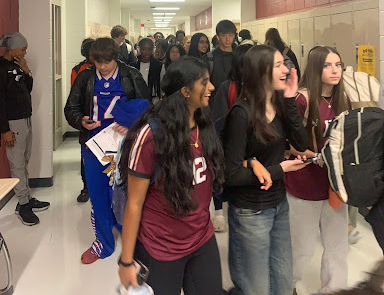
School zones have been set up to improve protection and monitor student motion. For example, all of the upstairs classrooms are in the purple zones, and students have been instructed to use the purple bathrooms when in the purple zone. Teachers largely encourage sticking to those zones, believing they keep order in the hallways.
However students are less convinced. An eleventh grader expressed, “I don’t really see students paying much attention to it. I don’t see it certainly helping.”
Despite these blended reviews, some students understand the intent behind school zones, with a 9th grader noting, “Yeah, that’s smart so that you can know where the students are.”
Navigating the effectiveness of Hammond rules calls for an ongoing talk between Administration and students. While the intentions behind these guidelines are protection, and accountability, receiving remarks from students are essential in refining their effectiveness.
Although there are mixed emotions and opinions concerning all the policies, Hammond is a school designed for students to thrive. These zones push students to thrive when they go to school and take advantage of the education available to them.
 hhsbearpress.com